
The Echtus Blueprint for Client Success
Setting the Vision. Drawing The Map.
Enterprise Education Architecture: Aligned Horizontally and Vertically
Behind most enterprise education failures is the same structural problem: education was built course by course, without a system designed to hold it together.
The symptoms are recognizable: progress measured in completions, knowledge gaps that persist despite the training, no clear ownership, no clear impact.
Echtus was founded to solve that at the root. Most organizations don't lack education. They lack architecture.
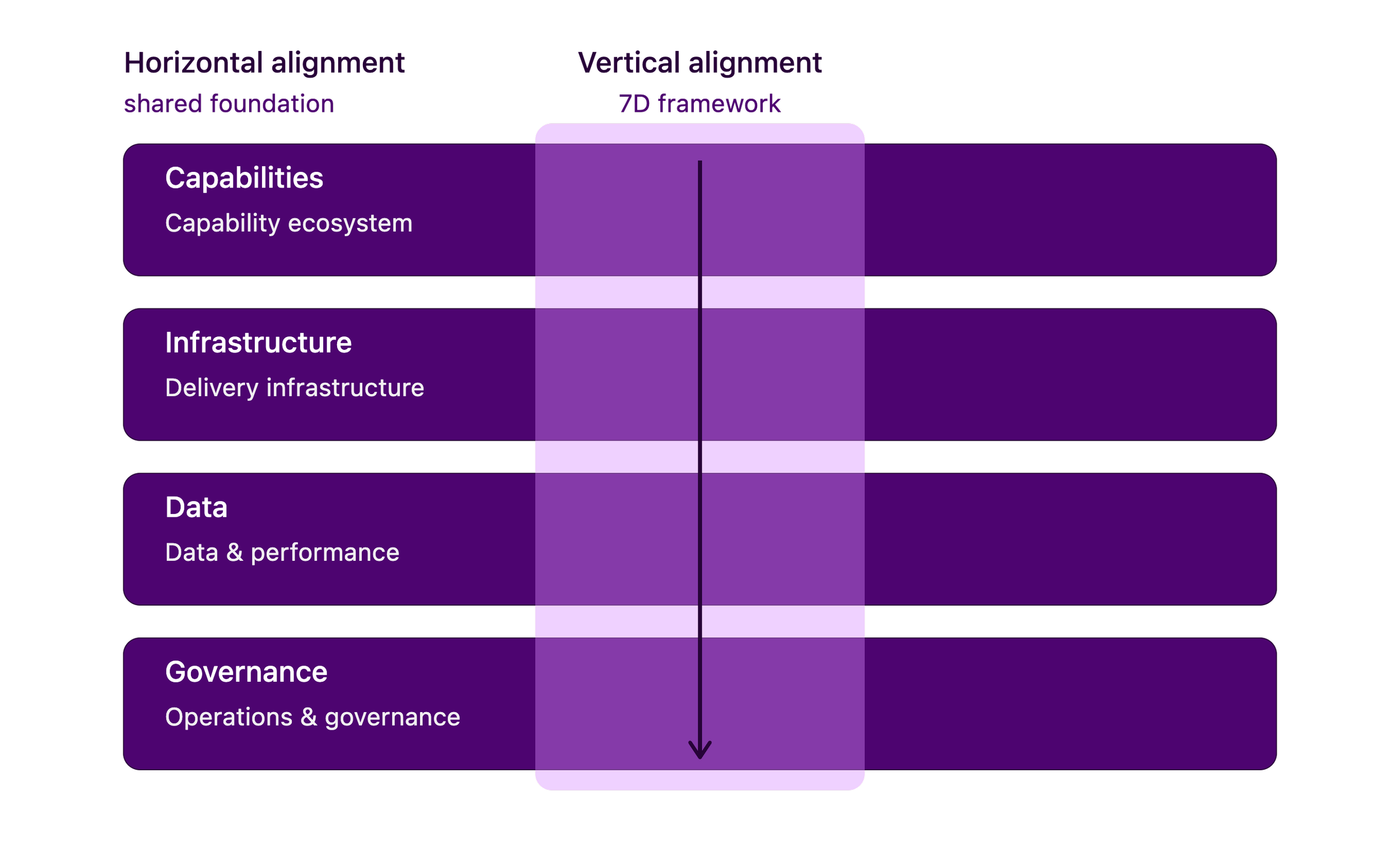
Architecture requires alignment on two axes. Horizontal alignment ensures the shared systems — capabilities, infrastructure, data, and governance — function as one coherent foundation across every program. Vertical alignment — the 7D Framework — ensures each individual program threads all the way from business goal to execution. Education architecture isn't complete until both axes hold.
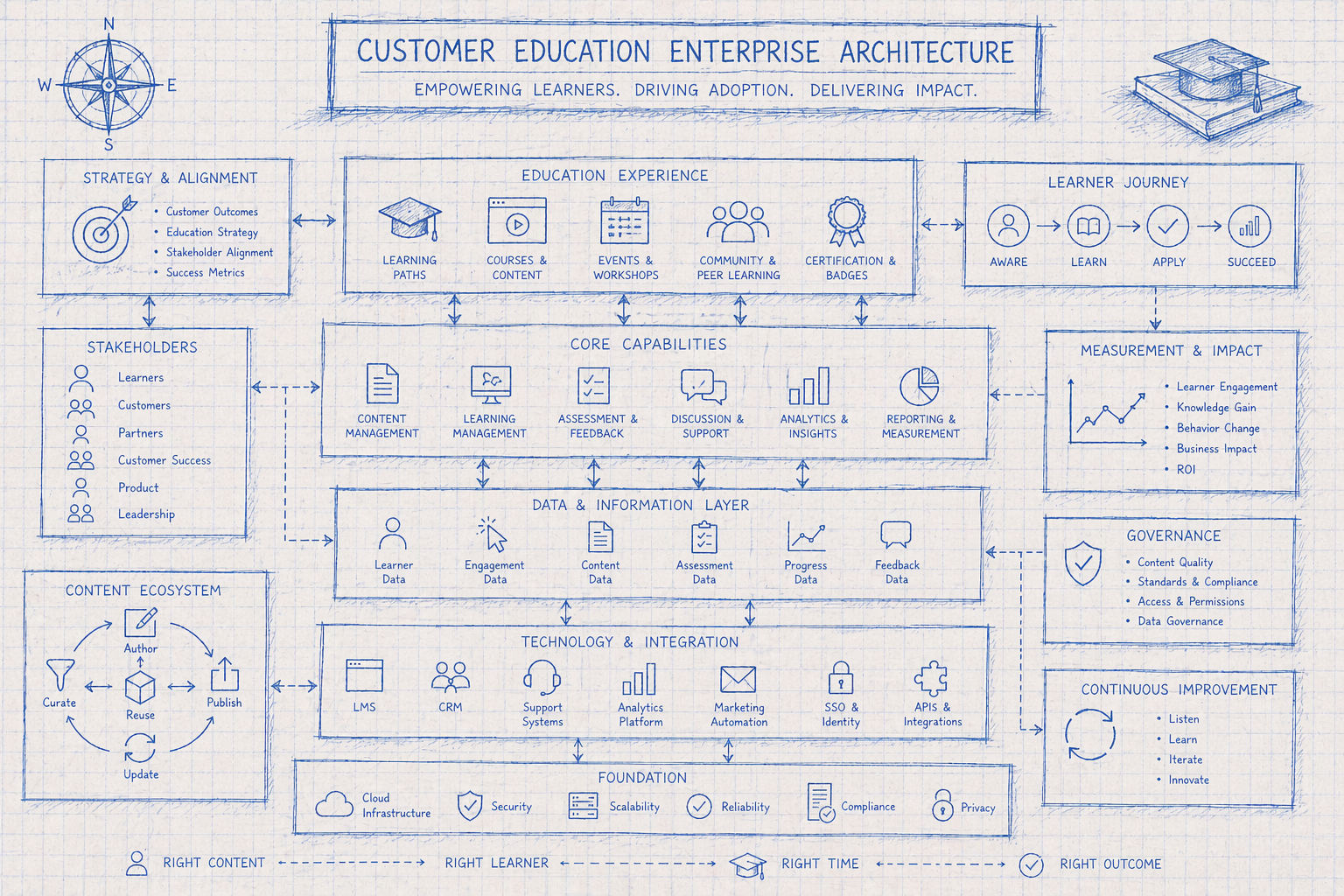
The Echtus Blueprint for Client Success
ABOUT THE ECHTUS BLUEPRINT
The Blueprint brings together the two axes required to build education as a business system:
HORIZONTAL ALIGNMENT
The Shared Foundation
VERTICAL ALIGNMENT
The 7D Framework
The Shared Foundation
HORIZONTAL ALIGNMENT
Horizontal alignment defines the systems that must run consistently across the entire education function — independent of any single program. These aren't built once per initiative; they're built for the enterprise and shared by all of initiatives. Together, they form the foundation every program stands on.
Operations & Governance
Process is standardized, ownership is clear, and content is governed as a coordinated source of truth across the system.
Education is managed, maintained, and kept aligned through clear ownership, standardized process, and governance that keeps content accurate and coordinated across the system. Duplication is minimized. Inconsistency is addressed at the system level. Execution is proactive rather than reactive, and the system retains coherence as it grows and changes.
Capability Ecosystem
The people, roles, and partners that build capability are understood as one connected system, with shared purpose and aligned responsibilities.
Capability is built across a network. Customers, partners, and internal teams all influence performance and adoption. When they are understood as a coordinated system, with clear learning pathways and enablement responsibilities across the lifecycle, education gains the reach and consistency it needs to drive results.
Data & Performance
Education connects to meaningful performance indicators, generates insights, and improves continuously as the business evolves.
Measurement is built into the architecture from the start. Education connects to meaningful indicators: activation, proficiency, retention, and business signals, generating feedback loops for continuous improvement. The aim is genuine impact measurement, grounded in business signals rather than participation counts. Education becomes a system that improves as the business changes.
Delivery Infrastructure
Systems, platforms, and content architecture are in place to support delivery that is consistent, scalable, and repeatable.
Strong education depends on the infrastructure underneath it. The systems, platforms, and content architecture are in place to make delivery consistent, scalable, and repeatable across audiences. The foundation supports growth, change, and ongoing execution. When infrastructure is well-designed, strong programs can be sustained and scaled over time.
"Horizontal alignment builds the shared foundation. The 7D Framework is our proprietary method for aligning every program to it."
The Proprietary Method
VERTICIAL ALIGNMENT
Vertical alignment is what connects a single program, top to bottom, to the business goal it exists to serve. The 7D Framework is our proprietary method for building that connection. The seven dimensions span the full scope of the work: from defining programs and audiences, through content and delivery, to marketing, measurement, and organizational alignment. Each dimension is applied to every engagement, calibrated to the specific scope and starting point.
Program Strategy
Define the formal pathways that move audiences toward proficiency and business value.
Program strategy shapes the structure of the learning journey. It defines the programs, sequences, and progression models that guide learners from onboarding through mastery. This dimension ensures education is organized around clear outcomes, with each program contributing to a coherent progression.
Audience Strategy
Identify the audiences education must serve and align experiences to their distinct needs.
Effective education systems are built around clearly defined audiences with specific needs, roles, and business contexts. This dimension clarifies who must be enabled across customers, partners, and internal teams, and what each group needs in order to succeed. It ensures the system reflects role, use case, and business context throughout.
Content Strategy
Establish the knowledge structure that supports consistency, relevance, and scale.
Content strategy defines what knowledge must exist, how it should be organized, and how it will be maintained over time. It ensures content functions as a strategic asset, organized for access, maintainability, and scale. Strong content structure supports consistency across audiences and durability as needs evolve.
Delivery Strategy
Determine how education will be delivered across platforms, formats, and learning environments.
Delivery strategy defines how the educational experience reaches the learner. It aligns modalities, platforms, and distribution methods to audience needs, operational realities, and desired outcomes. This dimension ensures delivery is intentionally designed to support access, consistency, and effectiveness.
Marketing Strategy
Drive awareness, engagement, and adoption of education as a business resource.
Even strong education systems underperform when the right audiences do not know they exist or understand their value. This dimension addresses how education is communicated, promoted, and activated across the organization and customer lifecycle. It ensures education is visible, relevant, and positioned for use.
Organizational Strategy
Align ownership, resources, and cross-functional support around education as a business capability.
Even a well-designed program underperforms without organizational buy-in behind it. This dimension addresses who owns the program, how it's resourced, and how cross-functional stakeholders — from leadership to the teams delivering the work day to day — stay aligned around shared priorities. It ensures each program has the internal support and accountability structure it needs to function as durable business infrastructure, not a standalone initiative.
Measurement Strategy
Define how success will be evaluated through meaningful performance signals and business impact.
Measurement strategy identifies what should be tracked, why it matters, and how those signals connect to business outcomes. It moves evaluation beyond participation metrics toward indicators such as activation, adoption, proficiency, retention, and operational progress. This dimension makes it possible to assess value and improve over time.
LET'S DISCUSS HOW WE CAN PUT THE 7D FRAMEWORK TO WORK FOR YOU!
HOW THE BLUEPRINT WORKS
The Foundation. The Thread.
Horizontal alignment and vertical alignment are two different ways of describing the same architecture — from two different angles.
HORIZONTAL ALIGNMENT
Builds the Foundation
Horizontal alignment describes what must be true across the whole education system, regardless of any one program. It's the shared foundation — capabilities, infrastructure, data, and governance — that every initiative stands on..
VERTICAL ALIGNMENT
Threads the Goal
The 7D Framework describes how a single program connects, top to bottom, to the business goal it exists to serve. It's the thread that runs from strategy down through execution, program by program.
When a client engages Echtus, the two axes answer two different questions.
Is our shared foundation strong enough to support every program we run?
HORIZONTAL ALIGNMENT ANSWERS:
Is this program built end-to-end to deliver the business result it's meant to?
VERTICAL ALIGNMENT ANSWERS:
This is why the Echtus approach is different from working with a specialist vendor, a content shop, or a learning platform. We see our role as being able to envision and deliver the entire architecture — both axes, together.
The Echtus Blueprint holds both the foundation and the thread — and every engagement, whether focused or holistic, is built on both.