
What Really Is Curriculum Design in Enterprise?
Curriculum design is becoming more visible in corporate and enterprise education. High-profile companies like Anthropic are actively hiring curriculum designers responsible for curriculum across all their audiences. Yet the term itself is still widely misunderstood.
When most people hear curriculum, they think of school: a science curriculum, an English curriculum, a college major, or a sequence of academic courses. In an enterprise setting, the word is often used to mean a list of courses, a collection of content, or perhaps a prescribed learning path.
Curriculum is more strategic than any of those things.
An enterprise curriculum is the intentional design and sequencing of objectives that enable people to achieve defined program outcomes and build the capabilities they need in their roles. Courses and learning assets are expressions of that curriculum. They are the vehicles through which parts of it may be delivered.
It’s important to recognize that difference. Organizations have accumulated a great deal of content without ever designing a coherent curriculum. Materials are created as requests arise: a product launches, customer education builds a course; a sales team identifies a gap, enablement creates a workshop; a customer asks a recurring question, customer success writes a guide. Each asset may be useful on its own, yet the full collection rarely reflects a purposeful plan for building capability.
Every organization has knowledge that it owns
Every enterprise has a body of proprietary knowledge that its employees, customers, partners, and other stakeholders need to understand. This includes:
Its products and how they are used, sold, implemented, and supported
Its point of view on the industry
Its methods, processes, and standards
The value it creates and how that value should be communicated
The practices required for different audiences to succeed
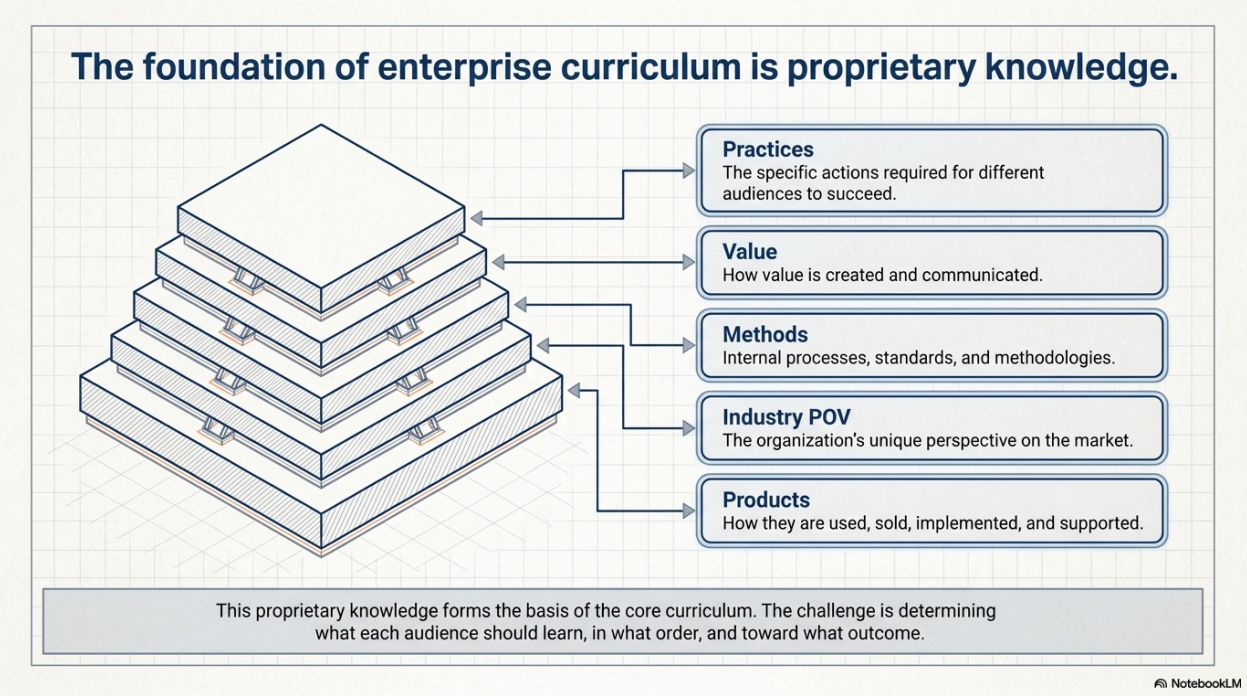
Together, this forms the basis of the organization’s core curriculum. Some of it may apply broadly across audiences. Other parts may serve a particular role, level of expertise, or stage in a journey. The organization needs a cohesive way to determine what each audience should learn, in what order, and toward what outcome.
Without that architecture, enterprise education tends to remain fragmented. Teams create overlapping content. Important capabilities receive little attention while familiar topics are covered repeatedly. Learners encounter information without the context or prerequisite knowledge required to apply it.
Curriculum design brings intention to that environment.
Curriculum begins with program outcomes
To understand curriculum, it helps to begin one level higher: with the program outcome.
In higher education, a degree program is designed around what a graduate should be capable of doing by the end of the program. A nursing program, for example, prepares an entry-level nurse to demonstrate a defined set of professional capabilities. Those outcomes guide the courses, clinical experiences, assessments, and learning sequence.
The same principle applies in an enterprise.
An employee onboarding program should define what a new employee needs to be capable of by the end of the first 30, 60, or 90 days. A customer onboarding program should define what successful adoption looks like for each role within the customer organization. A certification program should define the level of performance a credential holder must be able to demonstrate. An advanced enablement program should define how someone’s capabilities will expand beyond foundational proficiency.
These outcomes describe meaningful performance in context. They answer questions such as:
What should this person be able to accomplish after completing the program?
What behaviors would demonstrate readiness or proficiency?
Which capabilities matter for this role, at this stage?
What should success look like in the work itself?
In a B2B customer education program, for example, “the customer” is rarely a single learner. The daily user, administrator, technical stakeholder, buyer, and executive sponsor may each contribute to successful adoption in a different way. Each role therefore requires different outcomes, even when they share some foundational knowledge.
Defining the right outcomes is one of the first and most important curriculum decisions. The program needs outcomes that reflect the appropriate depth and scope for the audience. An entry-level onboarding experience, a long-term adoption program, and an expert certification may all address the same product while preparing people for very different levels of performance.
Curriculum maps the learning required to reach those outcomes
Once the program outcomes are clear, curriculum design works backward.
If a person must demonstrate a particular behavior, what skills make that behavior possible? What knowledge supports those skills? What prerequisite understanding must already be in place? Which objectives should be achieved first so that later learning has a stable foundation?
This is where curriculum becomes more than a list of topics.
Suppose a program outcome requires a seller to conduct an effective discovery conversation about a customer’s campaign strategy. The curriculum may need to build knowledge of advertising approaches, fluency in relevant terminology, skill in asking the right questions, judgment about which questions to ask in different situations, and the ability to connect customer needs to an appropriate solution.
Listing “campaign strategy” as a topic does little to explain how that capability develops. A curriculum breaks it into the objectives, knowledge, skills, practice, and progression required to produce the desired performance.
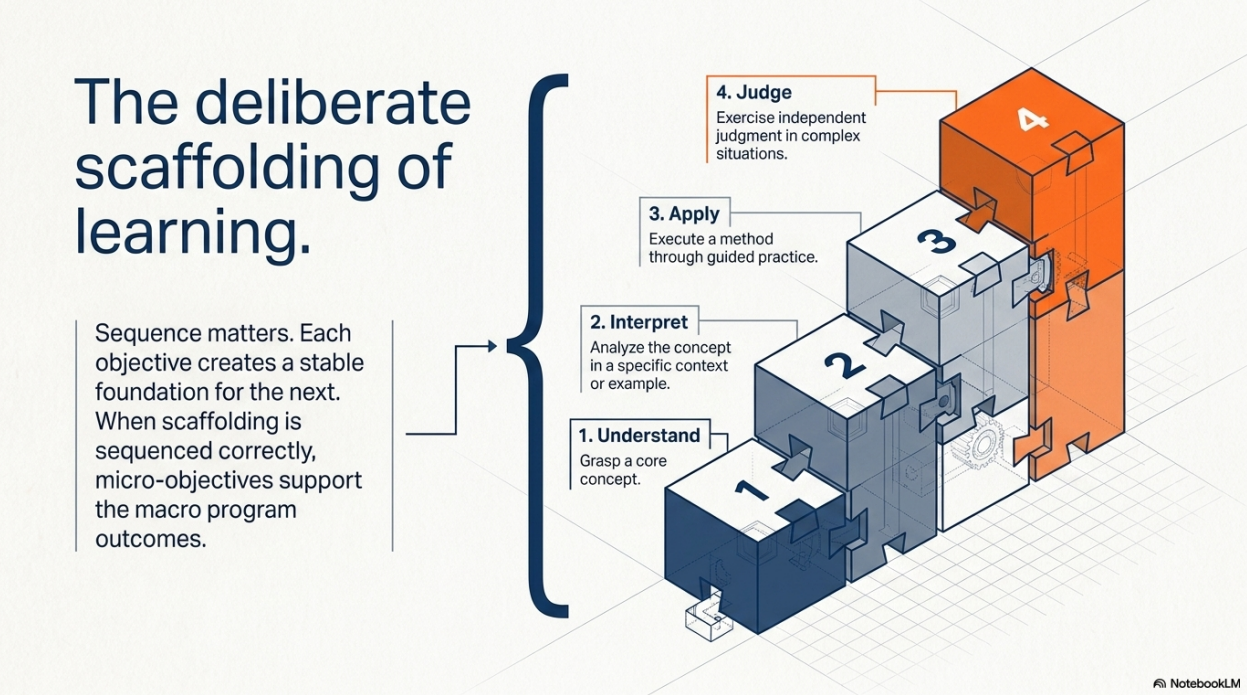
The sequence is highly relevant. Learners may need to understand a concept before they can interpret it in context. They may need to interpret examples before they can apply a method. They may need guided practice before they can exercise judgment independently. Each objective creates the foundation for the next.
This is the scaffolding of learning: a deliberate progression in which people build the knowledge and skill required to achieve increasingly complex objectives. When those objectives work together, they support the larger program outcomes.
Curriculum design and instructional design operate at different levels
Curriculum design is sometimes confused with instructional design. The two disciplines are closely related, and their boundaries may have overlapped more heavily earlier in the development of the instructional design field. In today’s enterprise environment, however, they generally operate at different levels.
Curriculum design works at the macro, strategic level. It determines which outcomes a program should produce, which objectives learners must achieve to reach those outcomes, and how those objectives should be organized and sequenced. Its focus is the architecture of learning across a program, audience, or enterprise.
Instructional design works at a more micro level. It focuses on how a particular learning experience should be designed so that learners can achieve its objectives. That may involve the design of a course, lesson, activity, assessment, or individual learning asset. Instructional designers draw on learning theory and instructional methods to determine how content should be presented, practiced, reinforced, and assessed.
The disciplines overlap around objectives. A curriculum designer must define and organize the objectives that lead to the intended program outcomes. An instructional designer must understand those objectives in order to create an effective learning experience around them.
The primary distinction is one of focus:
Curriculum design asks: Which objectives must people achieve, in what sequence, to develop the required capabilities?
Instructional design asks: How should a learning experience be designed so that people can achieve a particular set of objectives?
Curriculum provides the strategic architecture. Instructional design turns parts of that architecture into experiences through which learning can occur. Both are essential, but solving one level does not automatically solve the other. A well-designed course can still sit within a fragmented curriculum, just as a strong curriculum still requires effective instructional design to bring it to life.
Enterprise curriculum must also be modular
Academic programs often serve a relatively defined population pursuing a common credential. Enterprise curriculum has to work across a much more complex ecosystem.
An organization may need to educate employees, customers, partners, sellers, service teams, administrators, developers, buyers, and executives. These audiences share some needs and diverge sharply in others. Designing a separate curriculum from scratch for every audience creates duplication and inconsistency.
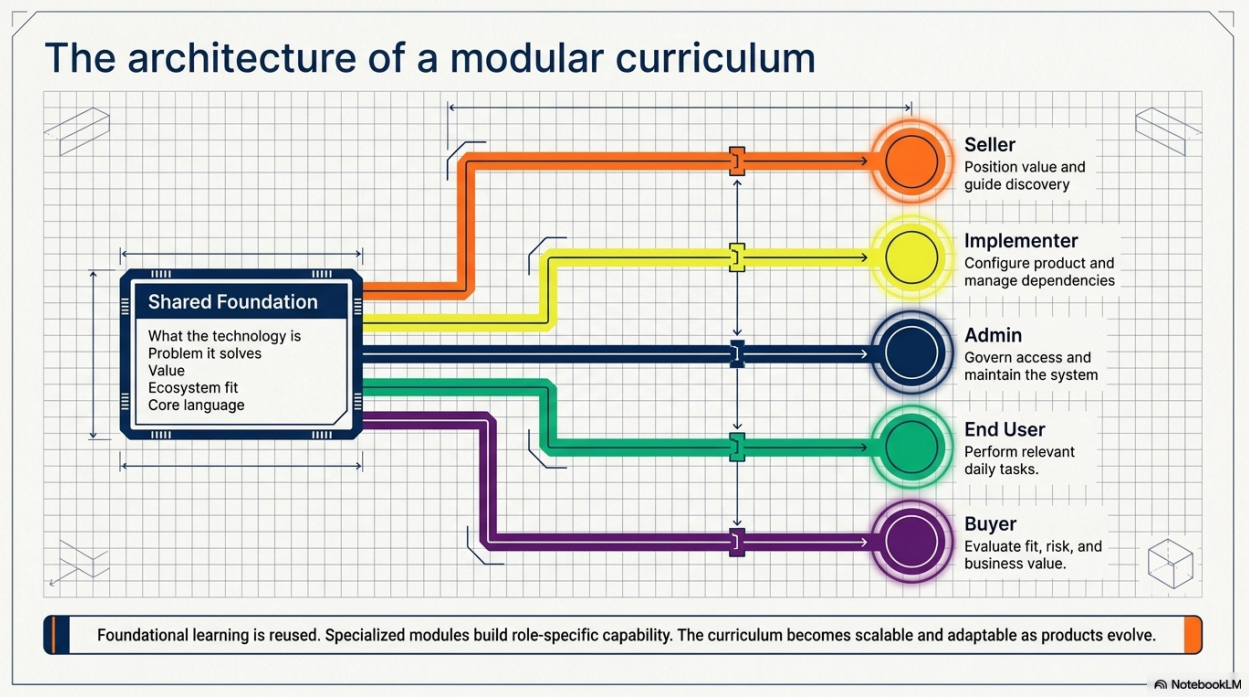
A modular curriculum identifies the learning that can be shared and the learning that must become specialized.
At a technology company, for example, many audiences may need a common foundation:
What the technology is
What problem it solves
How it creates value
How it fits within the broader market or ecosystem
The core language used to describe it
From there, the curriculum branches into role-specific pathways. A seller needs to position the value and guide discovery. A technical implementer needs to configure the product and manage dependencies. An administrator needs to govern access and maintain the system. An end user needs to perform relevant tasks. A buyer needs to evaluate fit, risk, and business value.
The structure resembles a well-designed college program. Students may share foundational courses early in their education, then move into increasingly specialized study as they progress toward the outcomes associated with a major. In the enterprise, shared foundations can similarly support multiple pathways, while specialized modules build the capabilities required for particular roles.
This modularity makes curriculum more scalable and adaptable. Foundational learning can be reused where appropriate. Specialized modules can be added, revised, or recombined as products, roles, and audience needs evolve. The organization can create consistency across the enterprise while preserving relevance for each learner.
Curriculum is a design, not a document
Curriculum can be represented in a map, framework, matrix, or other planning tool, but it is larger than any single artifact. It is the underlying design logic connecting business needs, program outcomes, learner roles, required capabilities, objectives, content, practice, and assessment.
There is also no single correct curriculum for a subject. Curriculum design involves choices:
Which outcomes matter most
What depth of capability the program should develop
Which knowledge and skills deserve emphasis
What learners are expected to know at the start
How objectives should be grouped and sequenced
Which elements can be shared across audiences
Where role-specific pathways should begin
What can realistically be taught within the available time and resources
Organizations cannot teach every person everything that could potentially help them succeed. Effective curriculum design focuses the learning on the capabilities most relevant for the intended audience and outcome. That work requires both science and judgment.
A course catalog tells people what exists. A curriculum explains why it exists.
As enterprise education becomes more strategic, organizations need to move beyond creating content in response to isolated requests. They need a coherent architecture for building capability across the people who use, sell, implement, support, buy, and influence their products.
That architecture begins with clear program outcomes. It identifies the behaviors that demonstrate those outcomes, the knowledge and skills that enable those behaviors, and the sequence in which learning should develop. It also creates modular foundations and specialized pathways that can serve a complex enterprise audience.
That is what curriculum looks like in the enterprise. It is not the inventory of what an organization has produced. It is the intentional design of what people need to learn, in what order, and for what purpose.
Ready to explore how a well-designed curriculum could uplevel your business?