
101 Strategic Ways to Use AI Agents in Customer Education
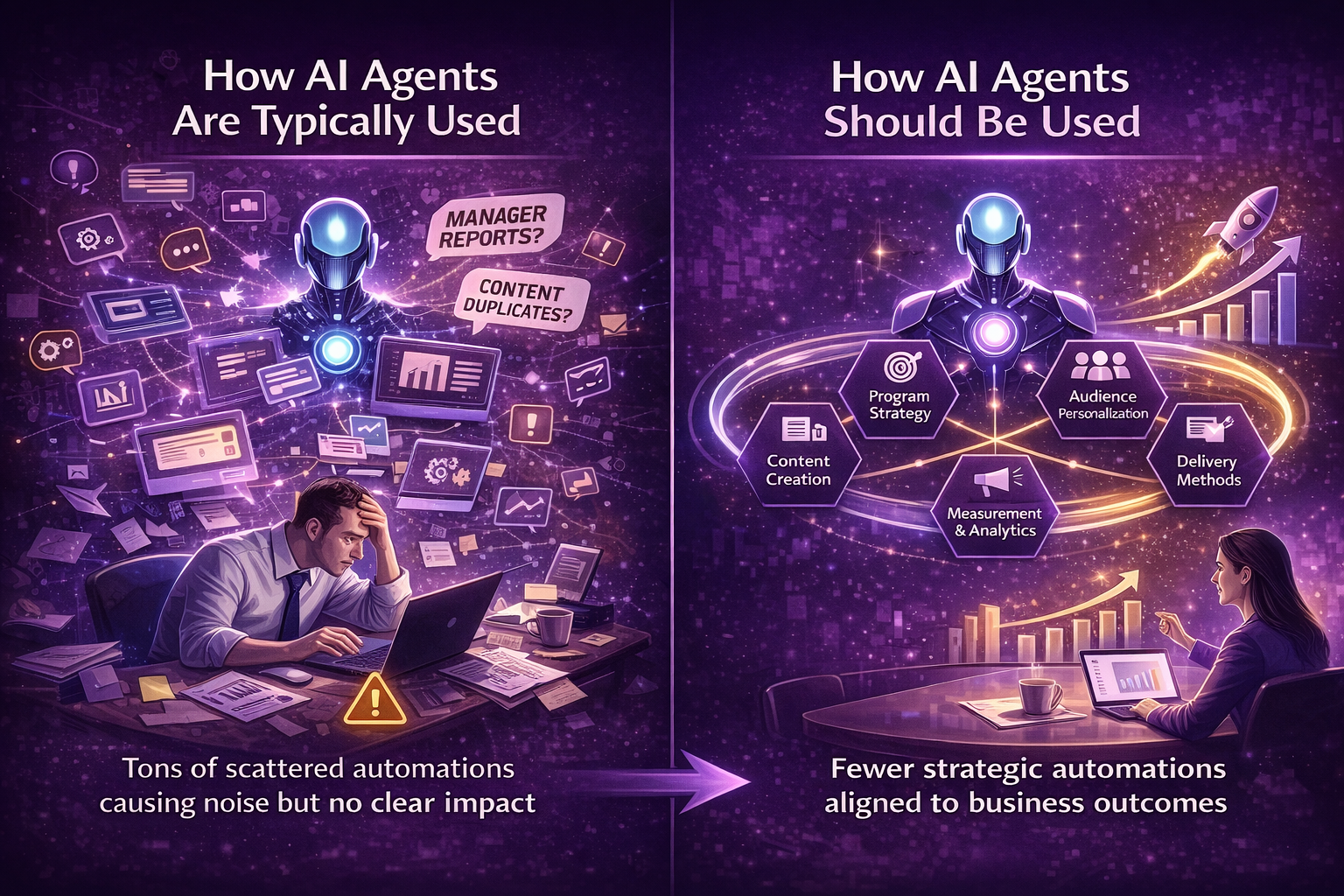
AI agents are quickly becoming the default “how” for scaling customer education: generating content, answering questions, nudging learners, and summarizing outcomes. The risk is that teams adopt agents as scattered automations—useful, but disconnected—then wonder why adoption, retention, and expansion don’t meaningfully change.
The strategic opportunity is to deploy agents as a system: aligned to business goals, audience needs, curriculum design, delivery moments, marketing motions, measurement loops, and the operating model required to sustain it. That’s exactly what our framework, the Seven Dimensions of Customer Education Strategy, is built to enable: a comprehensive plan to develop, deliver, and track learning outcomes that support business outcomes.
Below is a quick overview of the framework, what “agentic” customer education really means, and then 101 high-impact agent use cases organized by each dimension, so you can implement agents strategically.
What “Agentic” Customer Education Means
An “agent” is more than AI that just drafts content. Agents can monitor signals, make decisions, and execute workflows across your education ecosystem (LMS, content authoring, product analytics, CRM, support, and communications).
Used well, agents help you:
deliver the right learning at the right time,
personalize without exploding your workload,
and prove education is driving outcomes.
Used poorly, agents accelerate noise: more content, more messages, more dashboards—without impactful and lasting results.
How to Use Agents
Deploying agents means putting AI into production as a system that can interpret a goal, pull in context from your data, use tools, and take action across workflows, often with guardrails and human oversight. In practice, teams are deploying agents in three common ways today:
Low-/no-code agent builders inside enterprise platforms (for example, building and publishing agents connected to data sources and connectors),
Managed agent services from cloud providers that orchestrate model, data, and tool interactions,
Developer frameworks that let teams build agents that choose tools and iterate toward outcomes
In customer education, that typically looks like agents that monitor signals (product usage, LMS activity, support themes), decide the “next best” learning action, and execute: personalize pathways, trigger nudges, generate assets, escalate to humans, and continuously improve through feedback loops—as long as the agent system is grounded in the right strategy and governance.
The Seven Dimensions
The Seven Dimensions framework was developed to help organizations build customer education programs that are aligned to business goals and measurable results. Each dimension is a strategic “lane” where agents can amplify outcomes—if you’re clear on what success looks like.
Program Strategy
Program strategy is the alignment of education initiatives with business goals (onboarding, adoption, certification, enablement, etc.). Everything you do with your education should target a business problem or opportunity. Having a clear program strategy answers the “Why are we doing this?” question and sets the stage for all decisions you make moving forward.
Where agents can fuel program strategy:
Map business goals to program portfolio (onboarding, adoption, certification)
Detect new business priorities and propose program charters
Prioritize program investments based on impact + constraints
Link learning milestones to product milestones
Trigger education motions based on launch/renewal timelines
Identify expansion-ready accounts and suggest adoption programs
Recommend education-led growth campaigns by segment intent
Flag redundant programs and propose consolidation
Generate account-level education action plans for CS
Create quarterly program roadmaps with sequencing
Propose certification strategy (what, levels, audiences)
Detect program drift and recommend corrections
Orchestrate “next best education action” across signals
Forecast program demand for capacity planning
Audience Strategy
Mapping learner personas and segments to needs, contexts, and outcomes, and connecting them to the right programs - that’s an audience strategy. Personalization doesn’t start with content. It starts with clarity about who you serve and what success looks like for them.
Where agents can support your audience strategy:
Segment learners by intent (onboarding vs troubleshooting vs expansion)
Build persona profiles from CRM + usage + LMS signals
Route learners to paths via short intake interviews
Detect emerging learner types and recommend segmentation updates
Identify champions and notify CS
Recommend role-based paths automatically
Tailor examples by industry/maturity
Adjust difficulty based on confidence and error patterns
Create fast-track paths for experienced learners
Detect accessibility/language preferences and adapt experiences
Identify low-coverage accounts and recommend enrollment targets
Recommend cohort groupings for live training
Surface stuck learners and recommend interventions
Generate manager summaries of team progress
Content Strategy
Content strategy involves structuring content so it reliably produces learning outcomes and ladders to business outcomes, with modularity, taxonomy, and consistency. Agents make it easy to create content. Without content strategy, you’ll get AI-powered sprawl: duplicate modules, inconsistent messaging, and high maintenance.
Agentic use cases in content strategy:
Turn SME notes into objective-based lessons
Convert releases into “what changed” learning
Build modules from PRDs/help docs/SOPs
Create microlearning from recurring support themes
Generate role-based “impact guides” from roadmap updates
Localize modules and quizzes
Create accessible transcripts, alt text, and summaries
Generate scenarios and role plays aligned to objectives
Build practice labs/simulations from workflows
Auto-tag content by taxonomy, skill, level
Detect duplicated objectives and propose consolidation
Recommend consolidation when modules overlap
Propose modularization opportunities (“one concept, many placements”)
Monitor search queries to identify missing content
Flag outdated content after UI/product changes and draft updates
Delivery Strategy
Delivery is how you transmit the learning—modalities, methods, and tools—to the right learner at the right time. Delivery is where agentic education stops being “content” and becomes performance support—in the flow of work, with smart escalation to humans.
Agentic delivery use cases:
Recommend best modality per topic and audience
Provide in-app coaching at the moment of need
Offer step-by-step workflow guidance via chat
Deliver instant troubleshooting using KB + course content
Escalate to a human based on confidence/risk
Summarize lessons in preferred formats (quick/checklist/deep)
Translate jargon into plain language
Generate personalized study plans
Create live session agendas tailored to attendee roles
Generate facilitator guides from self-paced modules
Draft facilitator talk tracks aligned to narrative
Monitor live Q&A and recommend real-time answers
Summarize live sessions into microlearning follow-ups
Auto-create “top Q&A” KB entries after sessions
Recommend office hours topics based on support + learning signals
Marketing Strategy
Marketing strategy is essentially a plan to attract learners, sustain engagement, and re-engage them—plus internal awareness and cross-functional promotion. Even strong education fails if learners don’t discover it or don’t stick with it. Agents help education marketing become behavioral, segmented, and continuously optimized.
How agents can support your marketing efforts:
Draft and send nudges in your brand tone
Trigger follow-ups if learners don’t respond
Personalize subject lines based on segment behavior
A/B test messaging and select winners
Run re-engagement campaigns for dormant learners
Trigger “congrats + next step” sequences after milestones
Send manager-ready nudges to drive team participation
Generate learner onboarding messages tailored to persona + goals
Optimize send timing based on learner activity patterns
Create launch comms for new programs (internal + external)
Recommend next-best offer (course/webinar/cert) by intent
Trigger live event invites based on signals
Create drip sequences for certification journeys
Detect drop-off points and deploy targeted recovery messaging
Generate persona-based value propositions (“why this matters”)
Measurement Strategy
Measurement strategy involves the metrics, methods, and feedback loops that prove education is working—connecting engagement to content efficacy to behavior change and business results. Agentic systems can produce a lot of “activity.” Measurement is how you ensure that activity translates to outcomes.
Agentic use cases for measuring results:
Scan LMS data to flag at-risk customers/segments
Detect sudden engagement drops and open investigations
Compare segment engagement and flag anomalies
Connect learning engagement to product behaviors (adoption/usage)
Detect completions without behavior change; recommend interventions
Generate course health dashboards (drop-off, mastery, satisfaction)
Flag objectives with low mastery across cohorts
Produce weekly ROI summaries tied to program goals
Generate exec-ready reports (learning → behavior → business)
Detect education-influenced pipeline signals
Forecast certification volume and ops needs
Identify content that predicts retention/adoption; recommend scaling
Summarize learner feedback and propose iterations
Monitor assessment integrity signals (risk patterns)
Organizational Strategy
Where customer education lives, how it’s structured, and how it coordinates across teams (Product, CS, Support, Marketing) is all part of your organizational strategy. Agents change the operating model. Without governance, ownership, and escalation rules, agentic delivery becomes risky, inconsistent, and brittle.
How agents can fuel your organizational strategy:
Route inquiries to Education vs Support vs CS by intent
Create tasks/tickets for owners when risk thresholds hit
Produce weekly “voice of learner” summaries for product teams
Identify friction points and propose product + learning fixes
Generate audit-ready training evidence logs
Recommend staffing needs based on roadmap + demand
Draft escalation playbooks (when agents hand off to humans)
Generate cross-functional briefs for launches
Suggest governance rules (approvals, brand voice, constraints)
Maintain an auditable decision log of agent actions
Draft internal enablement updates for GTM teams
Create multilingual support macros linked to learning modules
Recommend interventions to reduce repeat tickets by theme
Convert customer questions into lesson proposals and assign owners
How to Use This List Without Creating Chaos
If you implement 20 agent use cases without a system, you’ll get an “AI layer” that’s busy—but not necessarily better. For a more strategic path:
Start with one business goal (reduce time-to-value, increase adoption, reduce ticket volume, increase renewal health, grow certification).
Choose one flagship program tied to that goal.
Implement one agent per dimension (7 total) so you build an end-to-end loop: strategy → personalization → content → delivery → engagement → measurement → governance.
Expand only after you can show that learning is driving behavior change and outcomes.
What’s Next
Agentic delivery is coming fast, but the winners won’t be the teams with the most automations. They’ll be the teams with the clearest strategy: a program portfolio tied to business priorities, audience paths built for relevance, modular content designed for reuse, delivery that supports performance in the flow of work, marketing motions that sustain engagement, measurement that proves impact, and an operating model built for governance and scale. That’s what the Seven Dimensions framework is designed to help you build.
If you want help turning these ideas into a coherent, measurable system, so you can prepare for an agentic future without creating sprawl, Echtus can help. We work with customer education leaders to design durable strategies, align stakeholders, define success metrics, and build the operating model that makes agentic delivery actually work.
Are you ready for an agentic future?